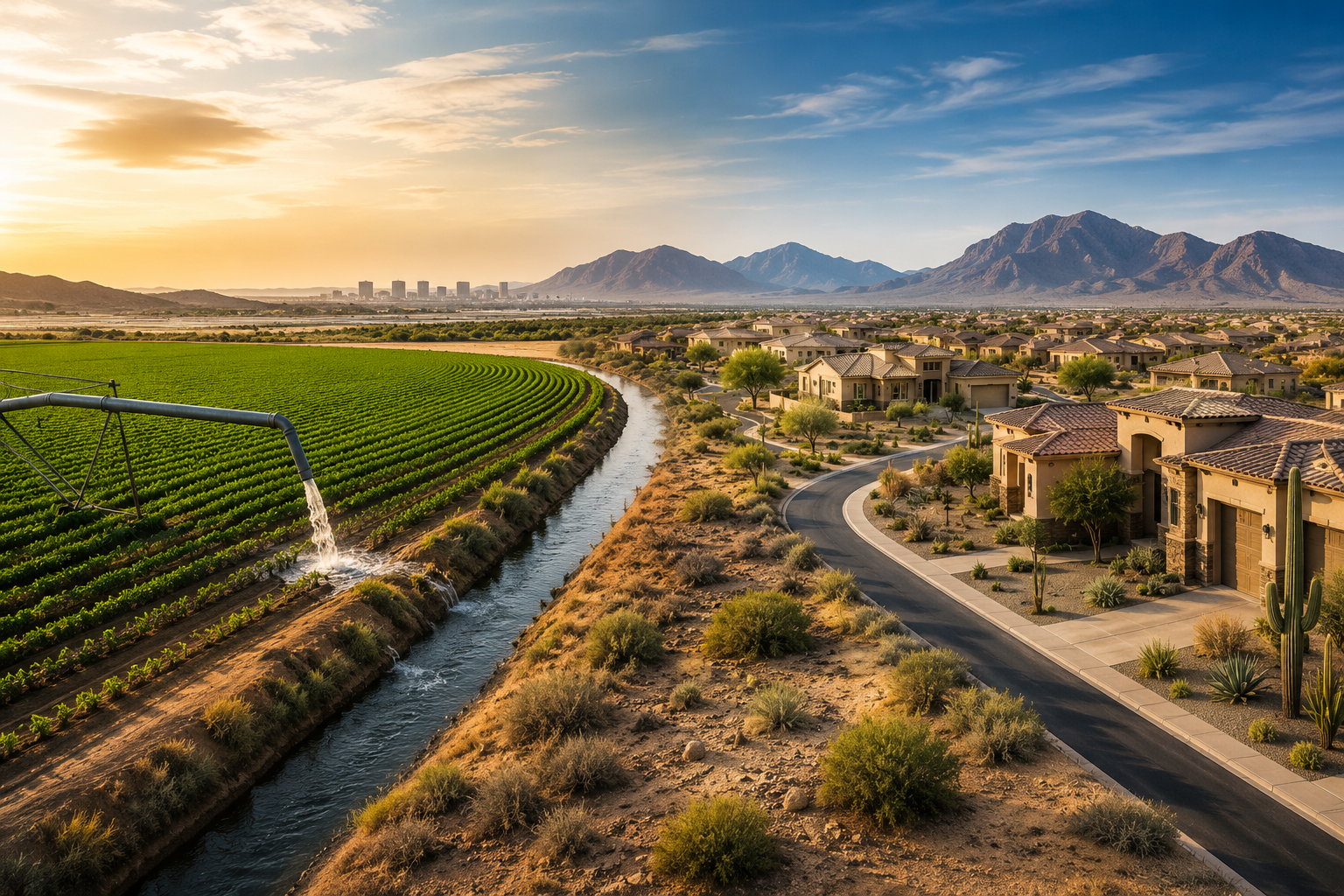
Arizona is confronting two realities that seem difficult to reconcile: Metro Phoenix continues to grow and needs more housing, while the state faces increasing pressure on one of its most important water sources—the Colorado River.
A relatively new program known as A2U, or Ag-to-Urban, attempts to address both problems at once.
The concept sounds counterintuitive: convert agricultural land into residential development and potentially reduce overall water consumption.
With major Colorado River cuts now looming, understanding how A2U works—and what it could mean for future Metro Phoenix real estate—has become considerably more important.
What Is A2U?
Arizona’s Ag-to-Urban program was created in 2025 and applies to eligible agricultural groundwater rights within the Phoenix and Pinal Active Management Areas.
Historically, certain farmland has held Irrigation Grandfathered Rights (IGFRs) allowing groundwater to be pumped for agriculture.
Under A2U, qualifying landowners can voluntarily relinquish those irrigation rights in exchange for Groundwater Savings Credits (GSCs). Those credits can then help satisfy the physical-water-availability component of Arizona’s 100-year Assured Water Supply (AWS) requirements for new development.
The underlying theory is straightforward: irrigated agriculture can consume substantially more water per acre than carefully regulated urban development.
If agricultural groundwater pumping is permanently retired and only a portion of the resulting savings supports new housing, Arizona can potentially accommodate additional development while reducing long-term groundwater demand.
In 2026, Arizona further amended the program through SB 1335, including provisions allowing qualifying agricultural operations to continue irrigating temporarily while an Assured Water Supply is being secured.
Why Does This Matter Now?
Because Arizona’s other major water story is moving in the opposite direction.
In August 2026, the federal government finalized a new Colorado River operating plan calling for approximately a 21% reduction in allocations to Arizona, California and Nevada beginning in 2027.
Depending on reservoir conditions, reductions could become substantially greater after 2028.
The plan is already facing legal opposition, including a lawsuit filed by Nevada, and Arizona officials have raised serious objections to how future shortages are being allocated.
For Metro Phoenix homeowners, however, this should not be interpreted as meaning residential taps are about to run dry.
Arizona’s water system is far more complicated than that.
Metro Phoenix uses a combination of Colorado River water, Salt and Verde River supplies, groundwater, reclaimed water and stored resources. The Arizona Department of Water Resources also emphasizes that its Assured Water Supply program is specifically intended to protect consumers by requiring qualifying new development to demonstrate water availability before growth occurs.
The more immediate issue may be where and how future housing gets built.
Water Is Becoming a Real Estate Issue
For decades, Phoenix real estate was primarily discussed in terms of location, schools, employment, transportation and available land.
Increasingly, another factor belongs on that list:
Water security.
A home located within an established municipal water system is fundamentally different from undeveloped land requiring a new Assured Water Supply determination.
Likewise, a luxury residence connected to a major water provider may present a very different long-term risk profile from an expensive custom home dependent upon an individual or shared well.
Those distinctions could become increasingly relevant to buyers, developers, lenders and ultimately property values.
Could Farmland Become More Valuable?
A2U may also change the economics of certain agricultural land.
Land with qualifying irrigation rights isn’t simply acreage. Those groundwater rights may now have additional strategic importance because relinquishing them can generate credits capable of supporting future development.
That doesn’t mean every farm can suddenly become a subdivision. Zoning, infrastructure, location, water-service availability and numerous regulatory requirements still apply.
But it introduces another variable into land valuation: the relationship between the land and its water rights.
What Does This Mean for Existing Homeowners?
Ironically, tighter water restrictions on future construction could ultimately make some existing housing more valuable.
If population continues growing while water policy constrains where new subdivisions can be built, established communities with secure infrastructure and reliable water service may face less competition from unlimited outward expansion.
That could become particularly meaningful for established areas of Phoenix, Scottsdale and other mature Valley communities.
A2U represents Arizona’s attempt to find another path: accommodate growth without simply increasing groundwater consumption.
Whether it succeeds on the scale envisioned remains to be seen.
But one thing is becoming increasingly clear.
In Arizona real estate, the value of a property may eventually depend not only on the land beneath it—but on the water beneath it, the water connected to it, and the legal right to use it.