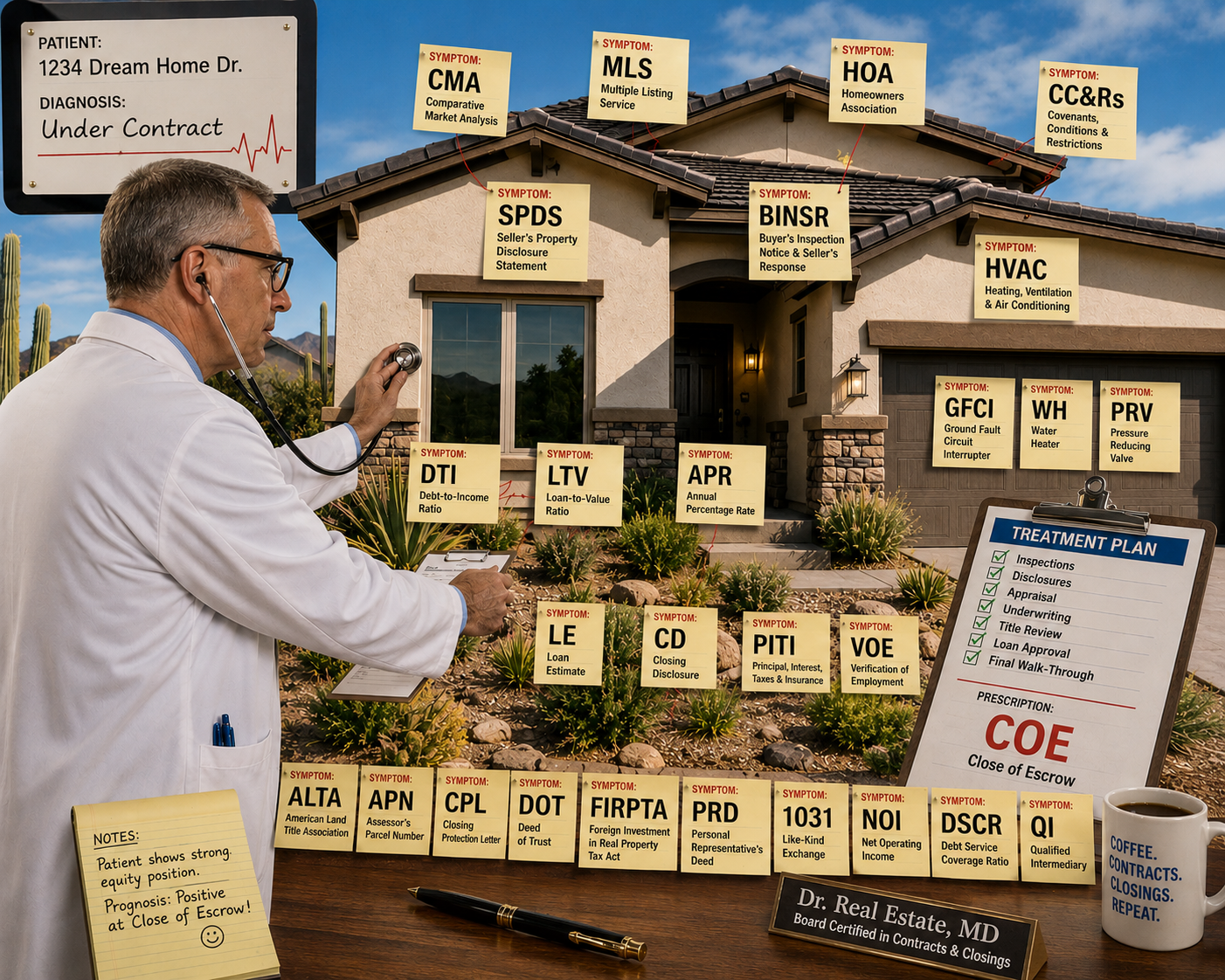
Your House Has Been Diagnosed With BINSR
Selling a home in Arizona begins much like visiting a doctor.
Everything seems fine until professionals start examining it.
You thought you owned a house.
The real estate industry has determined you actually own an MLS-listed asset with an HOA, CC&Rs, SPDS and several GFCI deficiencies pending BINSR resolution.
The prognosis is generally favorable.
Initial Examination
First comes the CMA — Comparative Market Analysis.
Think of this as taking the property’s temperature. Your agent studies comparable sales and determines that your home is worth considerably more than you paid for it, but slightly less than you told your neighbors.
The property enters the MLS — Multiple Listing Service.
If applicable, buyers examine the HOA and CC&Rs.
Then you’re given the SPDS — Seller’s Property Disclosure Statement, which is essentially your home’s medical history.
Roof leak in 2017?
We need to know.
Pool repair in 2021?
Write it down.
Strange noise that happened twice in the guest bathroom during the Obama administration?
Let’s discuss.
Further Testing Is Required
The buyer orders an inspection.
Your beautiful residence—described days earlier as exceptional, meticulously maintained and thoughtfully updated—is examined for three hours.
It emerges with 63 findings.
The buyer submits a BINSR.
Apparently your home has acute GFCI insufficiency, elevated HVAC age and a mildly concerning PRV.
Treatment options include repair, credit or pretending the request never arrived.
Meanwhile, the Buyer Is Being Examined
The lender has concerns of its own.
The patient has a DTI — Debt-to-Income Ratio, an LTV — Loan-to-Value Ratio, an APR, and a projected PITI.
An AUS sends the file through DU or LPA.
Underwriting orders a VOE and VOD.
Then comes the dreaded LOE — Letter of Explanation.
Apparently the buyer purchased furniture before closing.
The lender would like to know why.
The buyer explains that the house requires furniture.
Additional testing may be necessary.
Transfer to Escrow
The transaction is eventually admitted to title and escrow.
Specialists begin discussing ALTA, APN, CPL and DOT.
Complications may introduce FIRPTA.
Probate may require a PRD.
Investment property can present with NOI, DSCR, QI, DST and a potentially acute case of 1031.
Fortunately, there is a cure.
It’s called COE — Close of Escrow.
The deed records. Funds arrive. Keys transfer.
The patient is discharged.
The seller is cured of homeownership.
The buyer, unfortunately, has just tested positive for an HOA.
It’s chronic.