
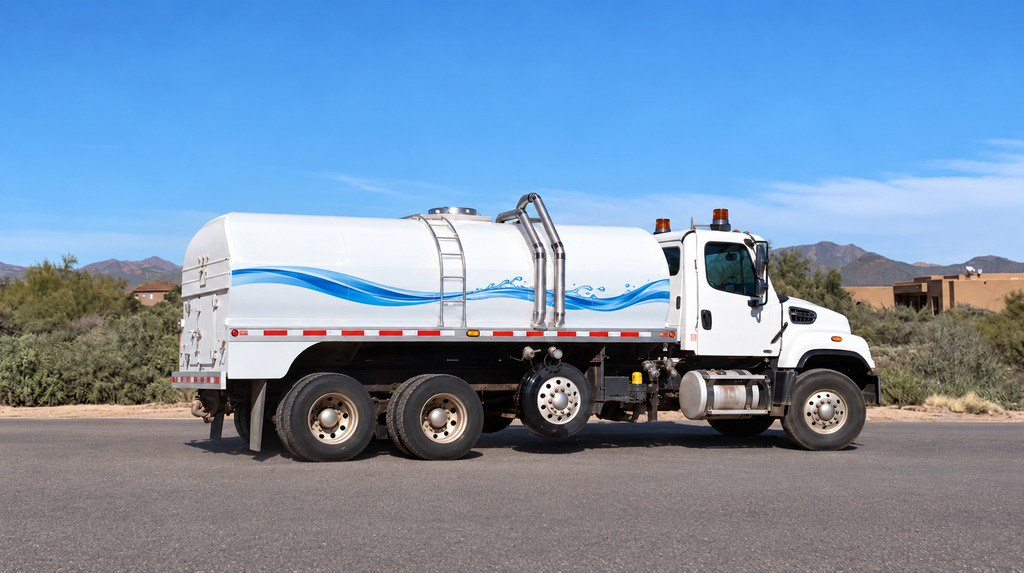
Why Some Arizona Homes Depend on Delivered Water
Most homeowners in Metro Phoenix take their water supply for granted. Turn on the faucet, and water flows. However, in rural communities surrounding the Valley, access to a dependable water source can be considerably more complicated.
Areas such as Rio Verde Foothills, New River, Desert Hills, and portions of Cave Creek, Apache Junction, San Tan Valley, Wittmann, and Tonopah contain properties without access to municipal water systems. In these locations, homeowners typically have two choices: drill a private well or have potable water delivered by truck and stored in an onsite cistern.
For many properties, hauled water isn’t simply a last resort. It can be a practical, predictable alternative to maintaining an expensive or unreliable private well.
The Problem With Shallow Aquifers and Private Wells
Arizona’s groundwater conditions vary considerably, even between neighboring properties. One home might have a productive well while another, only a short distance away, encounters shallow bedrock, limited groundwater or an aquifer that cannot consistently supply the household.
Extended drought, increased groundwater pumping and seasonal fluctuations can further complicate the situation. Wells that initially perform adequately may experience declining production, eventually requiring deeper drilling, additional storage or replacement.
Water quality presents another concern. Depending on the location, Arizona groundwater can contain high concentrations of dissolved minerals, including calcium and magnesium, along with naturally occurring contaminants such as arsenic or fluoride. Some wells also have elevated nitrate levels.
While many private wells provide excellent water, others require costly filtration, water softening or specialized treatment systems. A productive well is not necessarily a source of good-quality drinking water.
Why Hauled Water Can Be a Better Choice
Hauled water offers several advantages for properties with questionable groundwater conditions.
More consistent water quality: When purchased from a regulated potable-water source and transported in properly maintained equipment, delivered water can provide more predictable quality than untreated groundwater from a problematic private well.
No dependence on well production: Homeowners eliminate the uncertainty of seasonal well output, pump failures and declining aquifer levels as their primary water source.
Avoiding expensive drilling: Drilling a new well, particularly in rocky foothill terrain, can be expensive without any guarantee of an adequate supply. A properly designed cistern system offers an alternative with more predictable infrastructure requirements.
Controlled water inventory: Unlike a well, whose available production may fluctuate, a cistern provides a measurable quantity of stored water. Homeowners can monitor their consumption and schedule deliveries before supplies become critically low.
Rio Verde Foothills provides a particularly relevant example. After years of water-supply uncertainty, a permanent EPCOR water-filling station opened in January 2026 to serve eligible properties in the community. Water continues to reach individual homes by tanker truck, demonstrating how a centralized potable-water source can support residential neighborhoods without traditional municipal distribution lines.
Modern Cisterns Make Hauled Water Convenient
Today’s residential cistern systems are considerably more sophisticated than simple storage tanks.
A typical installation includes a 5,000- to 10,000-gallon potable-water tank, an electric booster pump, a pressure tank and appropriate plumbing connections. Once installed, the system supplies the home’s showers, sinks, toilets and appliances much like a conventional municipal water connection.
Tanks can be installed aboveground or underground, depending on site conditions, access and budget. Modern tanks manufactured from potable-water-rated polyethylene, fiberglass or other approved materials are designed for long-term water storage. Properly designed systems also incorporate sealed access covers, screened vents and provisions for cleaning and maintenance.
One particularly useful advancement is automatic water-level monitoring.
Wireless sensors can continuously measure the water level inside the cistern and transmit readings to a smartphone or computer. Homeowners can see approximately how many gallons remain, review consumption patterns and receive alerts when the water approaches a predetermined minimum.
Some systems can also detect unusually rapid water consumption, potentially identifying leaks before thousands of gallons are lost. Monitoring can even be integrated with delivery scheduling, reducing the inconvenience traditionally associated with hauled water.
What Size Cistern Does a Family of Four Need?
The Environmental Protection Agency estimates average residential water consumption at approximately 82 gallons per person daily. That translates to roughly 330 gallons per day, or approximately 10,000 gallons per month, for a family of four.
Households practicing water conservation can use considerably less, particularly with efficient plumbing fixtures and limited outdoor irrigation.
For a typical family of four, a 5,000-gallon cistern is a reasonable starting point, although a larger tank offers greater flexibility.
A 2,500-gallon cistern would last approximately one week at average household consumption. A 5,000-gallon system provides approximately 15 days, while a 10,000-gallon installation offers roughly one month of storage.
These estimates assume the full tank capacity is available and do not include a reserve. In practice, deliveries should be scheduled before the tank approaches empty.
For a family of four, a 5,000- to 10,000-gallon system generally offers the best balance between storage capacity, installation cost and delivery frequency. Larger households, extensive landscaping, swimming pools or livestock can significantly increase water requirements.
The tank should also be sized around the delivery company’s truck capacity to make efficient use of each trip.
Proper Installation and Maintenance Matter
Although hauled water can originate from a regulated drinking-water system, the homeowner remains responsible for maintaining sanitary onsite storage.
Cisterns should be protected against insects, debris, excessive sunlight and contamination. Periodic inspections, cleaning and water testing are important, and the plumbing system must be designed to maintain adequate household pressure.
Site planning is equally important. A full 5,000-gallon tank contains more than 41,000 pounds of water, making a properly prepared foundation essential. Delivery trucks also need sufficient access to safely refill the tank without damaging driveways or surrounding improvements.
A correctly installed and maintained system can provide years of dependable service.
A Practical Water Solution for Rural Arizona
Hauled water is sometimes perceived as an inconvenience or an indication that a property is less desirable. In reality, many rural Arizona homeowners intentionally choose stored, delivered water rather than invest in uncertain groundwater production.
For properties with unreliable aquifers, problematic well-water quality or no municipal water connection, modern cistern systems offer a practical alternative. With regulated potable-water sources, professional delivery services and automatic monitoring technology, living without a conventional water connection can be surprisingly straightforward.
The important consideration is understanding the property’s water infrastructure, ongoing delivery costs and the reliability of its supply before purchasing or building.
For questions about buying, selling or improving rural Metro Phoenix properties, contact The Cooper Group at Success Property Brokers. Our combined real estate and general contracting experience can help evaluate the practical considerations that make these properties unique.